5 Competition and mutualism
Species that use the same resources compete: their growth is reduced by each other’s presence. Other species help each other, as when insects pollinate plants. This week we analyse both kinds of interaction with the phase-plane tools of week 4, adding one more essential tool: nullclines. We also meet one of the classic principles of ecology, the competitive exclusion principle.
By the end of this week you should be able to:
- formulate and non-dimensionalise the Lotka–Volterra competition and mutualism models and interpret their parameters;
- find nullclines and use them to sketch phase portraits by hand;
- determine the steady states and their stability, and relate them to the outcomes of competition;
- state and explain the competitive exclusion principle;
- explain the unrealistic behaviour of the simple mutualism model.
Open the week 5 notebook in Colab
5.1 Four outcomes of competition
The Lotka–Volterra competition model extends logistic growth to two species: \[ \frac{dN_1}{dt}=r_1N_1\left(1-\frac{N_1+b_{12}N_2}{K_1}\right),\qquad \frac{dN_2}{dt}=r_2N_2\left(1-\frac{N_2+b_{21}N_1}{K_2}\right). \tag{5.1}\] Here \(r_i\) and \(K_i\) are the growth rate and carrying capacity of species \(i\). The competition coefficient \(b_{ij}\) says how much one individual of species \(j\) reduces the growth of species \(i\), measured in “individuals of species \(i\)”.
- With \(u_i=N_i/K_i\), \(\tau=r_1t\), \(\rho=r_2/r_1\) and \(a_{ij}=b_{ij}K_j/K_i\), show that Eq. 5.1 becomes \[\frac{du_1}{d\tau}=u_1(1-u_1-a_{12}u_2),\qquad \frac{du_2}{d\tau}=\rho u_2(1-u_2-a_{21}u_1). \tag{5.2}\]
- Interpret \(a_{12}\) in words. When is \(a_{12}\) large?
Pool your results from the launch investigation.
- Describe the four qualitatively different outcomes you found. Draw the \((a_{12},a_{21})\) square and divide it into four regions. Label each region with its outcome.
- In the region where both \(a_{12}\) and \(a_{21}\) are large, what decides which species wins?
- Does \(\rho\) affect the outcome, or only how it is reached?
- Explain each outcome ecologically in one sentence.
You will be asked to non-dimensionalise competition models and to predict the outcome of competition from the values of the competition coefficients.
5.2 Nullclines and phase portraits
A nullcline is a curve on which one of the two rates of change is zero. On the \(u_1\)-nullclines (\(du_1/d\tau=0\)) the flow is vertical. On the \(u_2\)-nullclines (\(du_2/d\tau=0\)) it is horizontal. Steady states lie where a \(u_1\)-nullcline meets a \(u_2\)-nullcline. With the nullclines and the direction of the flow in each region you can sketch a phase portrait by hand.
- Show that the \(u_1\)-nullclines of Eq. 5.2 are \(u_1=0\) and the line \(u_2=(1-u_1)/a_{12}\), and find the \(u_2\)-nullclines.
- Where do the lines meet the axes?
- In which region of the positive quadrant is \(du_1/d\tau>0\)? Where is \(du_2/d\tau>0\)?
Your lecturer will give each group one of the four cases (a) \(a_{12}<1\), \(a_{21}<1\); (b) \(a_{12}<1\), \(a_{21}>1\); (c) \(a_{12}>1\), \(a_{21}<1\); (d) \(a_{12}>1\), \(a_{21}>1\).
- On a large sheet, draw both nullclines, mark all steady states, and draw arrows showing the direction of the flow on the nullclines and in each region between them.
- Sketch several trajectories.
- Check your sketch with part B of the notebook.
- Post your sketch on the wall and compare with the other groups.
You will be asked to find nullclines, their intersections with the axes and the direction of flow in the regions between them.
The \(u_1\)-nullclines are \(u_1=0\) and \(u_2=(1-u_1)/a_{12}\) (meeting the axes at \((1,0)\) and \((0,1/a_{12})\)). The \(u_2\)-nullclines are \(u_2=0\) and \(u_2=1-a_{21}u_1\) (meeting the axes at \((1/a_{21},0)\) and \((0,1)\)). Below the line \(u_2=(1-u_1)/a_{12}\) species 1 increases, and below \(u_2=1-a_{21}u_1\) species 2 increases. The relative position of the two lines determines the outcome.
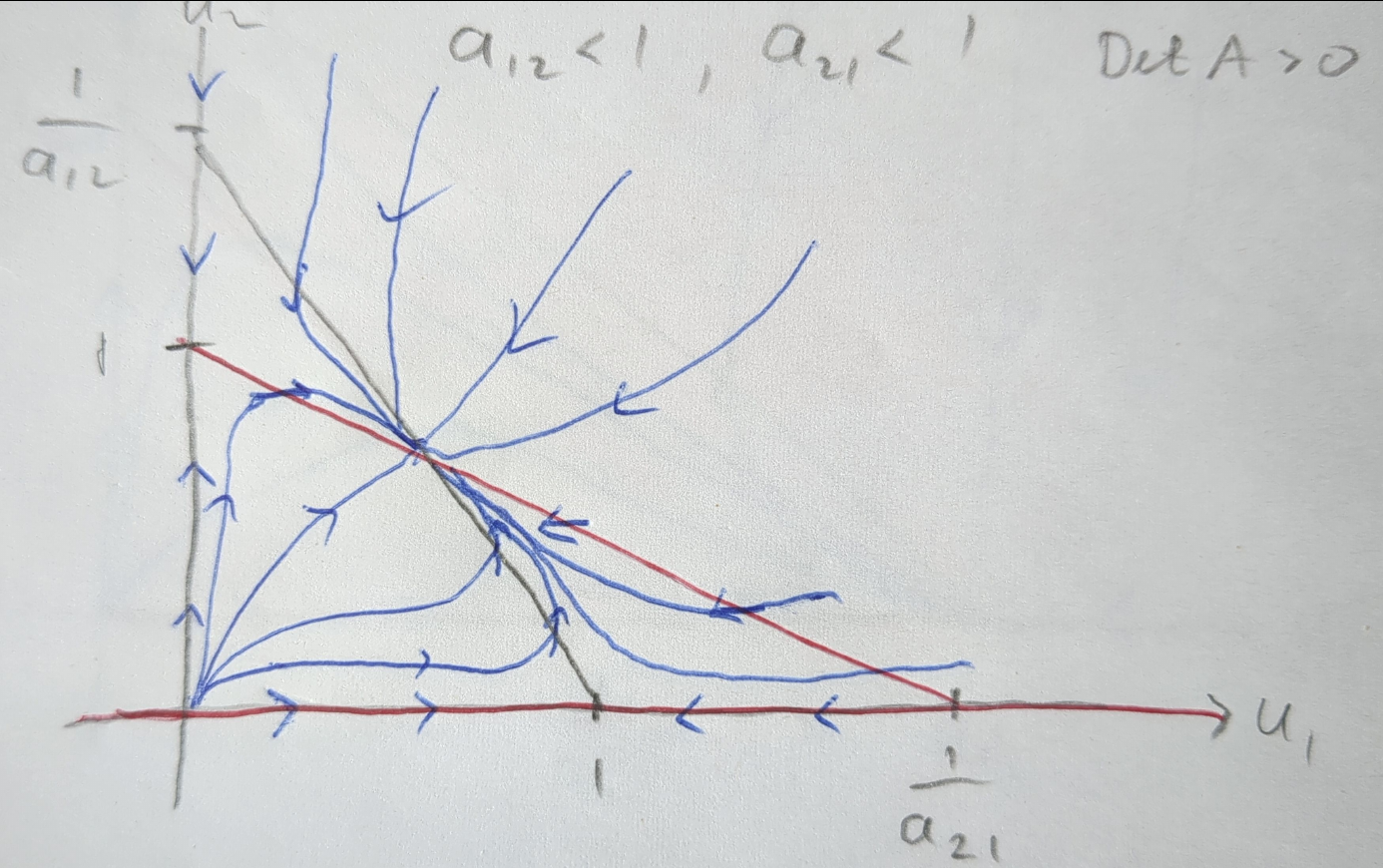
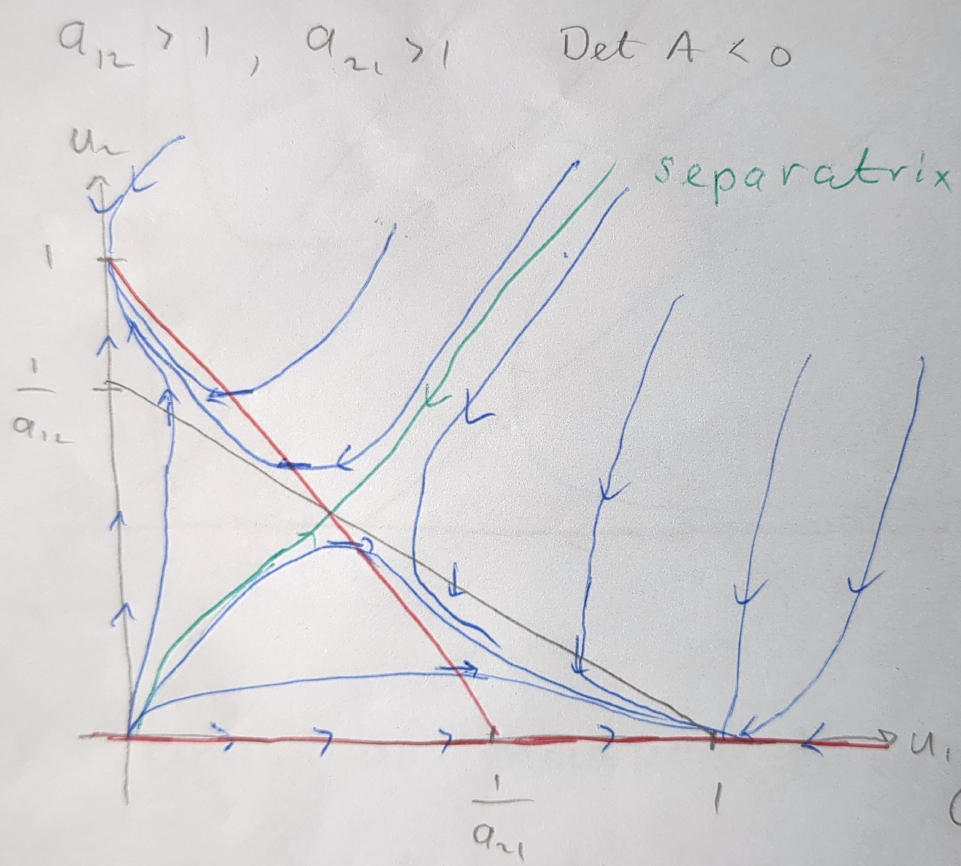
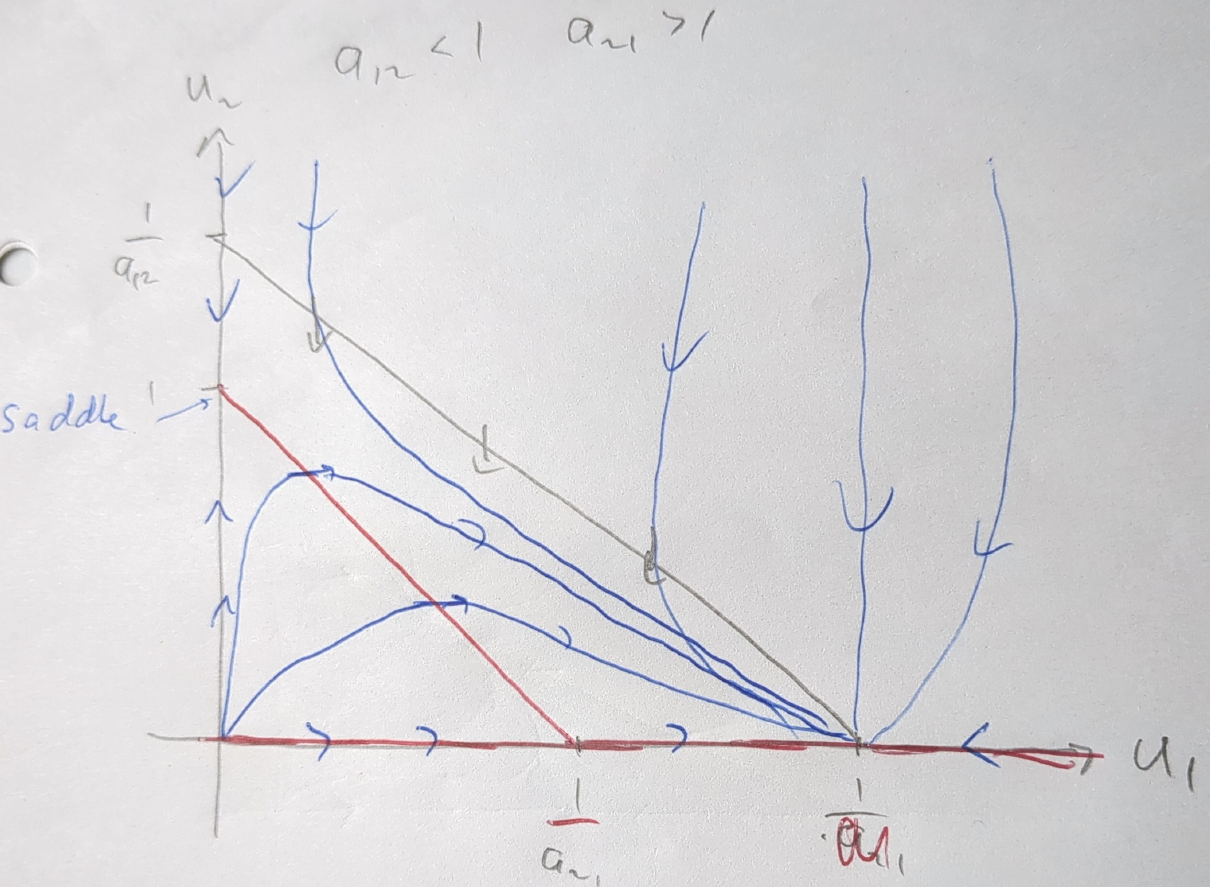
In the figures the nullclines are grey and red and trajectories are blue.
5.3 Stability and competitive exclusion
- Find the four steady states of Eq. 5.2, including the coexistence state \[(u_1^*,u_2^*)=\left(\frac{1-a_{12}}{1-a_{12}a_{21}},\frac{1-a_{21}}{1-a_{12}a_{21}}\right).\] When is the coexistence state in the positive quadrant?
- Compute the Jacobian and classify \((0,0)\), \((1,0)\) and \((0,1)\) in terms of \(a_{12}\) and \(a_{21}\).
- At the coexistence state, use \(1-u_1^*-a_{12}u_2^*=0\) and \(1-u_2^*-a_{21}u_1^*=0\) to simplify the Jacobian to \[A=\begin{pmatrix}-u_1^*&-a_{12}u_1^*\\-\rho a_{21}u_2^*&-\rho u_2^*\end{pmatrix}.\] Compute its trace and determinant and classify the coexistence state.
- Check that your results explain the four regions of your launch diagram.
You will be asked to find the steady states and the Jacobians of competition models, classify the steady states and identify the bifurcation values of the parameters.
The Jacobian of Eq. 5.2 is \[ A(u_1,u_2)=\begin{pmatrix}1-2u_1-a_{12}u_2&-a_{12}u_1\\-\rho a_{21}u_2&\rho(1-2u_2-a_{21}u_1)\end{pmatrix}. \]
- \((0,0)\): eigenvalues \(1,\rho>0\), an unstable node.
- \((1,0)\): eigenvalues \(-1\) and \(\rho(1-a_{21})\). It is stable if \(a_{21}>1\) and a saddle if \(a_{21}<1\).
- \((0,1)\): by symmetry, stable if \(a_{12}>1\) and a saddle if \(a_{12}<1\).
- Coexistence: \(\operatorname{tr}A=-u_1^*-\rho u_2^*<0\) and \(\det A=\rho u_1^*u_2^*(1-a_{12}a_{21})\). It lies in the positive quadrant if \(a_{12},a_{21}<1\) (then it is a stable node) or if \(a_{12},a_{21}>1\) (then it is a saddle).
| \(a_{21}<1\) | \(a_{21}>1\) | |
|---|---|---|
| \(a_{12}<1\) | stable coexistence | species 1 wins |
| \(a_{12}>1\) | species 2 wins | one species wins, depending on initial conditions |
In the bistable case the stable manifold of the saddle is a separatrix dividing the basins of attraction of \((1,0)\) and \((0,1)\). The parameter \(\rho\) does not affect which state is stable. Bifurcations happen at \(a_{12}=1\) and \(a_{21}=1\), where the coexistence state passes through \((0,1)\) or \((1,0)\) and exchanges stability with it (transcritical bifurcations).
Competitive exclusion principle (Gause, 1930s): two species competing for exactly the same limiting resources cannot coexist indefinitely. In our model coexistence requires \(a_{12}<1\) and \(a_{21}<1\), meaning that each species limits itself more than it limits the other. This is possible only if each species also has resources of its own, i.e. the species occupy different niches.
5.4 Mutualism
If each species benefits the other, the signs of the interaction terms flip: \[ \frac{du_1}{d\tau}=u_1(1-u_1+a_{12}u_2),\qquad \frac{du_2}{d\tau}=\rho u_2(1-u_2+a_{21}u_1),\qquad a_{12},a_{21}>0. \tag{5.3}\]
Will the two species end up above or below their carrying capacities (which are \(1\) in these units)? Could anything go wrong in this model?
- Explore the model for several values of \(a_{12}\) and \(a_{21}\). Where is the coexistence steady state? Is it stable?
- Find a condition on \(a_{12}\) and \(a_{21}\) under which the populations grow without bound. Look at the nullclines in that case.
- Find the nullclines and all steady states of Eq. 5.3.
- Show that the coexistence state has \(\det A=\rho u_1^*u_2^*(1-a_{12}a_{21})\) and decide when it is stable.
- Explain geometrically, using the nullclines, why solutions grow without bound when \(a_{12}a_{21}>1\).
You will be asked to analyse mutualism models and general two-species interaction models: nullclines, steady states, stability and the type of interaction.
The steady states are \((0,0)\) (unstable node), \((1,0)\) and \((0,1)\) (saddles) and \[ (u_1^*,u_2^*)=\left(\frac{1+a_{12}}{1-a_{12}a_{21}},\frac{1+a_{21}}{1-a_{12}a_{21}}\right), \] which is positive only if \(a_{12}a_{21}<1\). It then has \(\operatorname{tr}A<0\) and \(\det A>0\), so it is stable, and both populations exceed their carrying capacities. For \(a_{12}a_{21}>1\) the nullclines \(u_2=(u_1-1)/a_{12}\) and \(u_2=1+a_{21}u_1\) diverge instead of crossing, and all solutions grow without bound: May’s “orgy of mutual benefaction”. Realistic mutualism models need the benefit to saturate, for example with a Holling type II term.
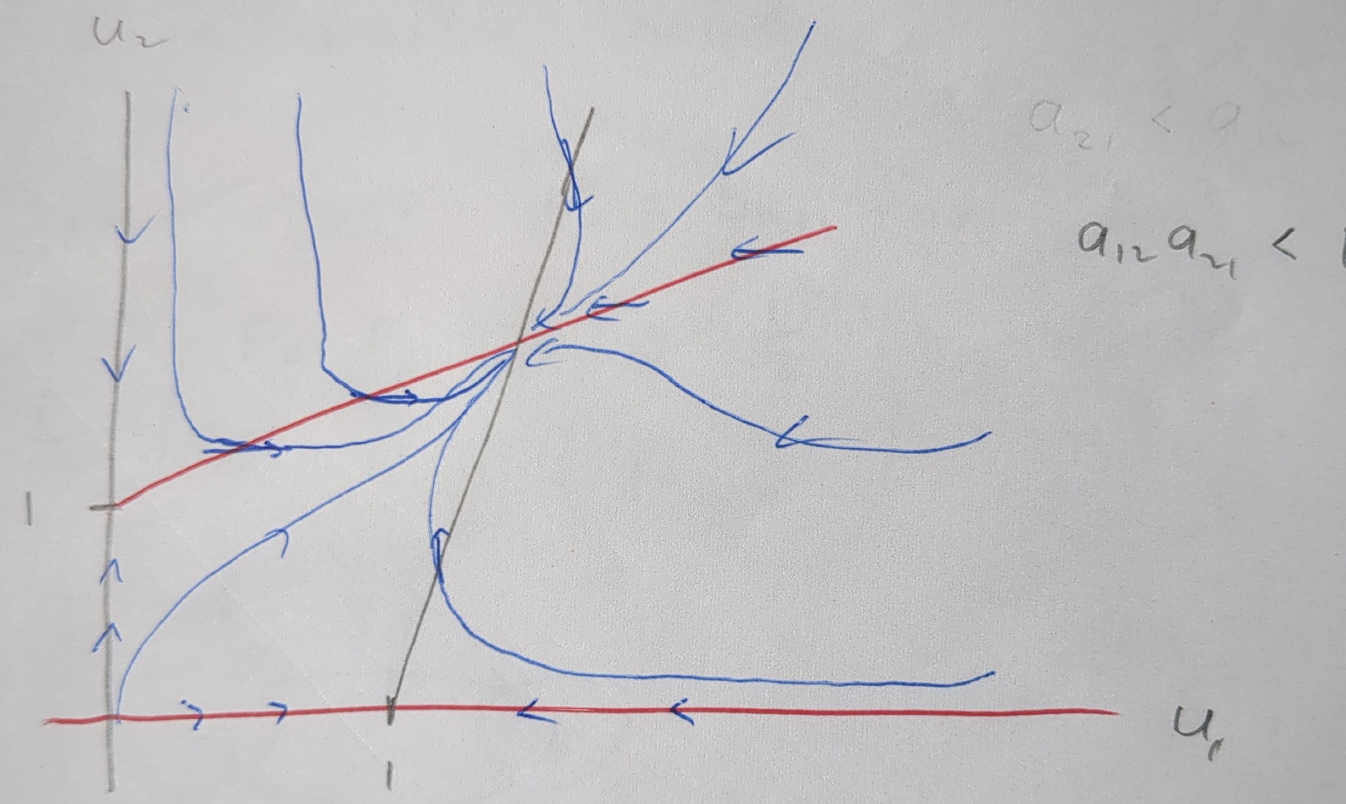
5.5 Exam-style questions
Consider \[ \frac{dN_1}{dt}=r_1N_1\left(1-\frac{N_1}{K_1}-b_{12}\frac{N_2}{K_1}\right),\qquad \frac{dN_2}{dt}=r_2N_2\left(1-b_{21}\frac{N_1}{K_2}\right), \] with all parameters positive.
What type of interaction exists between \(N_1\) and \(N_2\)? [1 mark]
Non-dimensionalise with \(u=N_1/K_1\), \(v=N_2/K_2\) and a suitable non-dimensional time. Give the resulting parameters and equations. [3 marks]
Find the steady states and classify them. At what parameter values do bifurcations occur? [6 marks]
Find the nullclines and sketch the phase plane (you will need two sketches). [4 marks]
Describe the ecological circumstances under which each species goes extinct. Show that competitive exclusion holds for all parameter values. [3 marks]
Competition: each species reduces the growth of the other. Species 2 has no self-limitation.
With \(\tau=r_1t\), \(R=r_2/r_1\), \(A=b_{12}K_2/K_1\), \(B=b_{21}K_1/K_2\): \(\frac{du}{d\tau}=u(1-u-Av)\), \(\frac{dv}{d\tau}=Rv(1-Bu)\).
Steady states: \((0,0)\), \((1,0)\) and \(\left(\frac1B,\frac{B-1}{AB}\right)\). The Jacobian is \(\begin{pmatrix}1-2u-Av&-Au\\-RBv&R(1-Bu)\end{pmatrix}\). \((0,0)\): eigenvalues \(1,R\), an unstable node. \((1,0)\): eigenvalues \(-1\) and \(R(1-B)\), a saddle for \(B<1\) and a stable node for \(B>1\). The third state is positive only for \(B>1\). There, using the steady-state conditions, \(A=\begin{pmatrix}-1/B&-A/B\\R(1-B)/A&0\end{pmatrix}\), so \(\det A=R(1-B)/B<0\): the coexistence state is a saddle whenever it is ecologically relevant. There is a transcritical bifurcation at \(B=1\), where the coexistence state passes through \((1,0)\).
\(u\)-nullclines: \(u=0\) and \(v=(1-u)/A\). \(v\)-nullclines: \(v=0\) and the vertical line \(u=1/B\). Case \(B<1\): the line \(u=1/B\) lies to the right of \((1,0)\), and \(v\) grows everywhere with \(u<1/B\), so trajectories go to large \(v\) and \(u\to0\). Case \(B>1\): the nullclines cross at the saddle, and the separatrix through it divides trajectories going to \((1,0)\) from those in which \(v\) grows and \(u\to0\).
For \(B<1\) species 1 always goes extinct and species 2 grows without bound (it has no self-limitation). For \(B>1\) the outcome depends on the initial condition: below the separatrix species 2 dies out, above it species 1 dies out. Coexistence is never stable, since the only coexistence state is a saddle. So competitive exclusion holds.
For the mutualism model Eq. 5.3 with \(a_{12}a_{21}<1\):
Find all steady states. [3 marks]
Show that the coexistence steady state is stable. [4 marks]
Sketch the phase portrait, including the nullclines. [3 marks]
What happens if \(a_{12}a_{21}>1\)? Why is this unrealistic, and how could the model be improved? [3 marks]
\((0,0)\), \((1,0)\), \((0,1)\) and \(\left(\frac{1+a_{12}}{\delta},\frac{1+a_{21}}{\delta}\right)\) with \(\delta=1-a_{12}a_{21}>0\).
At the coexistence state, using \(1-u_1^*+a_{12}u_2^*=0\) and \(1-u_2^*+a_{21}u_1^*=0\): \(A=\begin{pmatrix}-u_1^*&a_{12}u_1^*\\ \rho a_{21}u_2^*&-\rho u_2^*\end{pmatrix}\), so \(\operatorname{tr}A<0\) and \(\det A=\rho u_1^*u_2^*(1-a_{12}a_{21})>0\). It is stable, and in fact a node, since \((\operatorname{tr}A)^2-4\det A=(u_1^*-\rho u_2^*)^2+4\rho a_{12}a_{21}u_1^*u_2^*>0\).
Nullclines \(u_1=0\), \(u_2=(u_1-1)/a_{12}\) (slope \(1/a_{12}\)), \(u_2=0\) and \(u_2=1+a_{21}u_1\) (slope \(a_{21}<1/a_{12}\)). The lines cross at the coexistence state, which attracts all trajectories in the positive quadrant.
The lines no longer cross and populations grow without bound. Real benefits saturate, so a saturating (e.g. Holling type II) mutualism term should be used.
For each model, state the type of interaction and interpret each term (\(a,b,c,d,e>0\)):
\(\dot x=x(a-bx-cy)\), \(\dot y=y(-d+ex)\)
\(\dot x=x(a-bx+cy)\), \(\dot y=y(d-y-ex)\) [4 marks]
Predator–prey: \(x\) is logistic prey, eaten by predator \(y\). The predator dies at rate \(d\) without prey and reproduces in proportion to the prey eaten.
\(x\) benefits from \(y\) (\(+cy\)) while \(y\) is harmed by \(x\) (\(-ex\)): parasitism or exploitation (a “+/−” interaction, like predation but with logistic growth of both species).
Summary
- The Lotka–Volterra competition model has four outcomes, determined by \(a_{12}\) and \(a_{21}\): coexistence (both \(<1\)), exclusion of one species (one \(<1\), one \(>1\)), and bistability (both \(>1\)).
- Nullclines make phase portraits easy to sketch: the flow is vertical on \(\dot u_1=0\) and horizontal on \(\dot u_2=0\), and steady states lie at the intersections.
- Competitive exclusion: stable coexistence requires intraspecific competition to be stronger than interspecific competition.
- Mutualism with linear benefits leads to stable coexistence above the carrying capacities if \(a_{12}a_{21}<1\) and to unbounded growth otherwise.
5.6 Launch: males and females
Open the week 6 notebook in Colab
So far all individuals of a species were identical. The simplest structure is the division into females \(F\) and males \(M\): \[ \frac{dF}{dt}=-\mu_FF+b_F\,\varphi(F,M),\qquad \frac{dM}{dt}=-\mu_MM+b_M\,\varphi(F,M), \] where \(\mu_F,\mu_M\) are death rates, \(b_F,b_M\) birth rates of daughters and sons, and the mating function \(\varphi(F,M)\) says how the birth rate depends on the numbers of females and males.
- Predict: what properties should a sensible mating function have? What happens if there are no males?
- In part A of the notebook, try the three mating functions \(\varphi=FM\), \(\varphi=F\) and \(\varphi=2FM/(F+M)\). For each, describe what happens to the numbers and to the sex ratio \(M/F\).
- For \(\varphi=FM\), find out what happens for small and for large initial populations.
- For the other two, does the long-term sex ratio depend on the initial numbers? On which parameters does it depend?